Pakistan, China issue 5-point initiative for restoring peace in Middle East – World
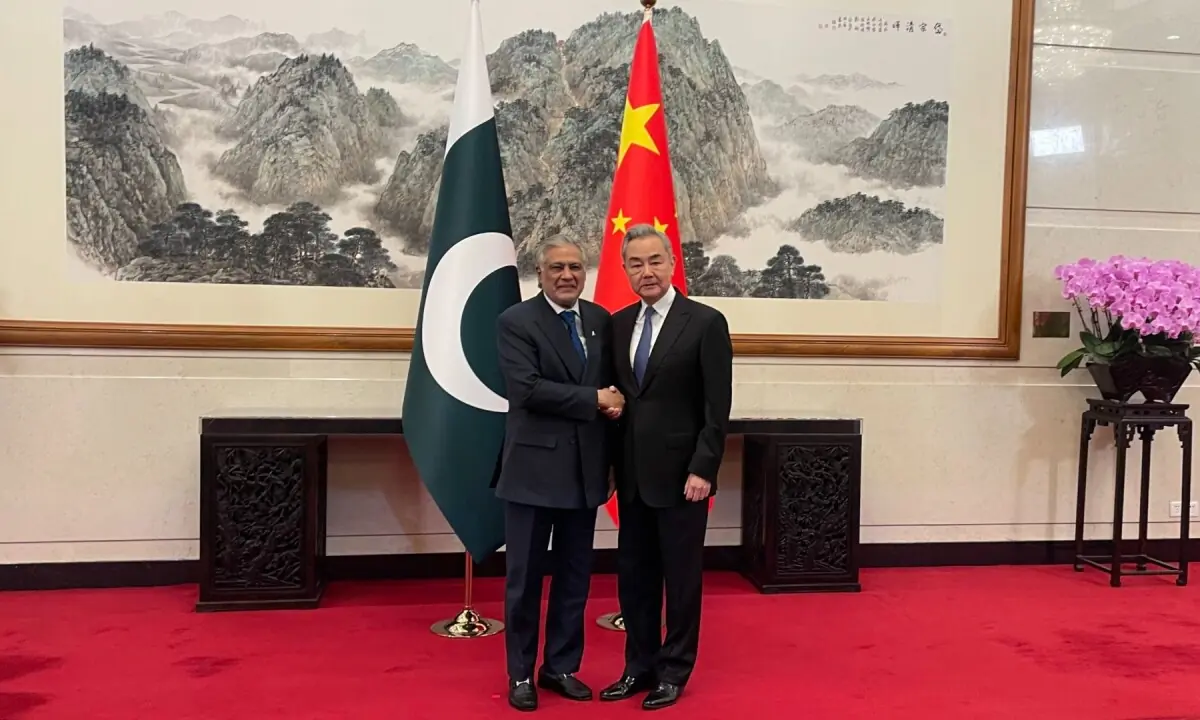
Pakistan and China on Tuesday issued a five-point initiative for restoring peace and stability in the Gulf and the Middle East amid the US-Israeli war on Iran, in which they called on the immediate cessation of hostilities and starting peace talks as soon as possible.
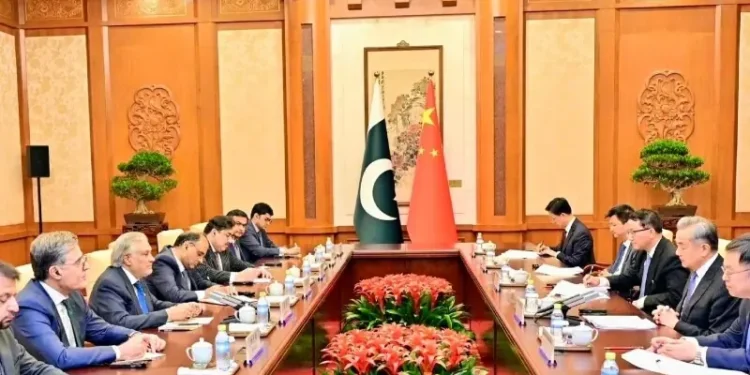
The development came as Deputy Prime Minister and Foreign Minister Ishaq Dar undertook a one-day visit to Beijing at the invitation of China’s Foreign Minister Wang Yi, for “in-depth discussions on regional developments”, according to the Foreign Office (FO).
In a statement released after the meeting, the FO said the two reviewed the situation in the Gulf and Middle East region and put forward five points.
Both countries called for the “immediate cessation of hostilities and utmost efforts to prevent the conflict from spreading”. Humanitarian assistance must be allowed to all war-affected areas, the statement said.
The two countries also called for starting peace talks as soon as possible.
“Sovereignty, territorial integrity, national independence and security of Iran and the Gulf states should be safeguarded. Dialogue and diplomacy is the only viable option to resolve conflicts,” the statement said.
“China and Pakistan support the relevant parties in initiating talks, with all parties committing to a peaceful resolution of disputes, and refraining from the use or the threat of use of force during peace talks,” it added.
Both countries also called for the security of non-military targets.
“The principle of protecting civilians in military conflict should be observed. China and Pakistan call on parties to the conflict to immediately stop attacks on civilians and nonmilitary targets, and fully adhere to International Humanitarian Law, and stop attacking important infrastructure, including energy, desalination and power facilities, and peaceful nuclear infrastructure, such as nuclear power plants,” the statement said.
Further, they said that the security of shipping lanes should be ensured.
“The Strait of Hormuz, together with its adjacent waters, is an important global shipping route for goods and energy. China and Pakistan call on the parties to protect the security of ships and crew members stranded in the Strait of Hormuz, allow the early and safe passage of civilian and commercial ships, and restore normal passage through the Strait as soon as possible,” the statement said.
Lastly, the two countries called for “efforts to practice true multilateralism, to jointly strengthen the primacy of the United Nations, and to support the conclusion of an agreement for establishing a comprehensive peace framework and realising lasting peace based on the purposes and principles of the UN Charter and international law”.
Bilateral ties, regional developments discussed
Another statement by the FO said Dar held a meeting with Yi at the invitation of the latter, adding that the meeting was held in “an exceptionally warm and cordial atmosphere, featuring hours of engagement from restricted talks to delegation-level discussions”.
The two sides reviewed the full spectrum of bilateral relations, exchanged views on regional developments in West Asia, and discussed a wide range of issues of mutual interest, the statement said.
It said that as “Pakistan and China commemorate the 75th anniversary of diplomatic relations this year, both sides reaffirmed their unwavering commitment to further strengthening the all-weather strategic cooperative partnership”.
“Particular emphasis was placed on advancing high-quality development, deepening economic and strategic cooperation, including under CPEC 2.0, and enhancing high-level exchanges and collaboration across all domains,” the statement read.
On the evolving situation in West Asia, it said, both sides underscored their shared commitment to peace, stability, and dialogue, and issued a five-point initiative aimed at promoting regional peace and stability.
“Foreign Minister Wang Yi appreciated Pakistan’s constructive and consistent diplomatic efforts in this regard,” it said, adding that the two sides also reaffirmed their close coordination at multilateral fora and agreed to remain in regular and close contact.
“The visit once again reflected the enduring warmth, mutual trust, and iron-clad friendship that define Pakistan-China relations,” the statement said.
Later, FM Dar posted on X that he was “delighted to be in Beijing”, saying that his conversations with Yi, “from restricted talks to delegation-level discussions followed by a warm and gracious dinner, extended over three hours of substantive, thoughtful, and forward-looking exchanges”.
“Always a great pleasure to engage with a trusted friend and an iron-clad partner,” he added.
China to ‘strengthen’ cooperation with Pakistan on Iran
Earlier in the day, China said it would strengthen cooperation with Pakistan on Iran.
“The two foreign ministers will strengthen strategic communication and coordination on the Iran situation and… make new efforts toward advocating for peace,” Chinese foreign ministry spokeswoman Mao Ning told a press conference, calling China and Pakistan “all-weather” strategic partners.
Dar landed in Beijing in the late afternoon and was greeted by high-ranking Chinese officials. He was later received by the Chinese foreign minister at Diaoytai State Guest House for their bilateral meeting.
The trip marks his second official visit to Beijing this year, the FO noted in a post sharing Dar’s departure from Islamabad.
In an earlier statement, the FO stated that Pakistan and China enjoy an all-weather strategic cooperative partnership, characterised by “close coordination and regular consultations” on regional development and international issues.
In a telephone conversation with Dar last week, Wang had said that initiating peace talks in the war involving Iran “is no easy task”, but noted that such efforts would be “conducive to restoring normal navigation through the Strait of Hormuz”.
During the call, Wang also conveyed China’s support for Pakistan’s role as a mediator.
The Chinese foreign minister had also spoken to Dar on March 10, where he had commended Pakistan’s constructive role in promoting de-escalation and stability in the Middle East amid war.
Tehran envoy welcomes Islamabad’s ‘proactive diplomatic initiatives’
Commenting on Islamabad’s diplomatic efforts, Iran’s Ambassador to Pakistan Reza Amiri Moghadam appreciated the “initiative and goodwill and good office by the friendly & brotherly country of Pakistan to stop the US-Israeli aggression against Iran and restore peace and stability to the region”.
“Iran welcomes Pakistan’s proactive diplomatic initiatives based on goodwill to restore peace and [bring] lasting stability to the region,” the envoy reiterated in another post.
His statement comes after Islamabad hosted a four-country meeting over the weekend involving Saudi Arabia, Türkiye and Egypt, where foreign ministers met for about 100 minutes and emphasised the need for de-escalation and dialogue.
The ministers backed efforts to create conditions for structured negotiations between Washington and Tehran.
Following the meeting, Dar publicly hinted that Pakistan could host direct US-Iran talks in the coming days, as Islamabad stepped up efforts to position itself as a venue for negotiations.
Pakistan has taken centre-stage in the process to mediate between the US and Iran, being carried out in collaboration with Riyadh, Ankara and Cairo, with officials confirming that indirect exchanges between Washington and Tehran are continuing through structured message relays, rather than direct contact.
Additional input from AFP, Ameer Hamza